Horizontal and Vertical Linearities
Key facts
- Two free calculators: horizontal linearity from multiple back-wall echo positions, vertical linearity from paired echo heights stepped up the screen
- Both follow the AS 2083 method, which needs only a V1 calibration block and the instrument itself, with no electronic measuring equipment
- Horizontal linearity checks distance and therefore reported depth; vertical linearity checks amplitude and therefore flaw sizing and acceptance
- Each chart can be copied to the clipboard or downloaded as a PNG for the instrument's calibration record
- ASME BPVC Section V requires instrument linearity checks at the beginning of each period of extended use or every 3 months, whichever is less; AWS D1.1 sets two months
- Nothing is uploaded: the calculations run in your browser
Two free calculators for the instrument linearity checks every ultrasonic technician has to produce evidence of. Enter your readings and each one plots the result against its tolerance bands, ready to copy or download into the instrument’s calibration record. Everything runs in your browser; nothing is uploaded.
Horizontal linearity is a distance check. It asks whether the position of an echo along the time base is proportional to the distance the sound actually travelled, which is what decides the depth a reflector is reported at. Vertical linearity is an amplitude check. It asks whether the height of an echo on the screen stays proportional to the strength of the signal received, which is what decides how a flaw is sized and whether it is accepted or rejected.
The two are independent. An instrument can pass one and fail the other, so both are checked, and both belong on the same record.
Horizontal Linearity: AS 2083—2005
Use V1 calibration block on the 25mm thick side.
Use 4 or 5 echoes for ranges up to 100 mm; use 10 to 20 echoes for 100 mm to 500 mm.Echo Positions (d(n))
| Echo # | d(n), mm |
|---|---|
| 1 | |
| 2 | |
| 3 | |
| 4 | |
| 5 | |
| 6 | |
| 7 | |
| 8 | |
| 9 | |
| 10 |
Reading the horizontal chart
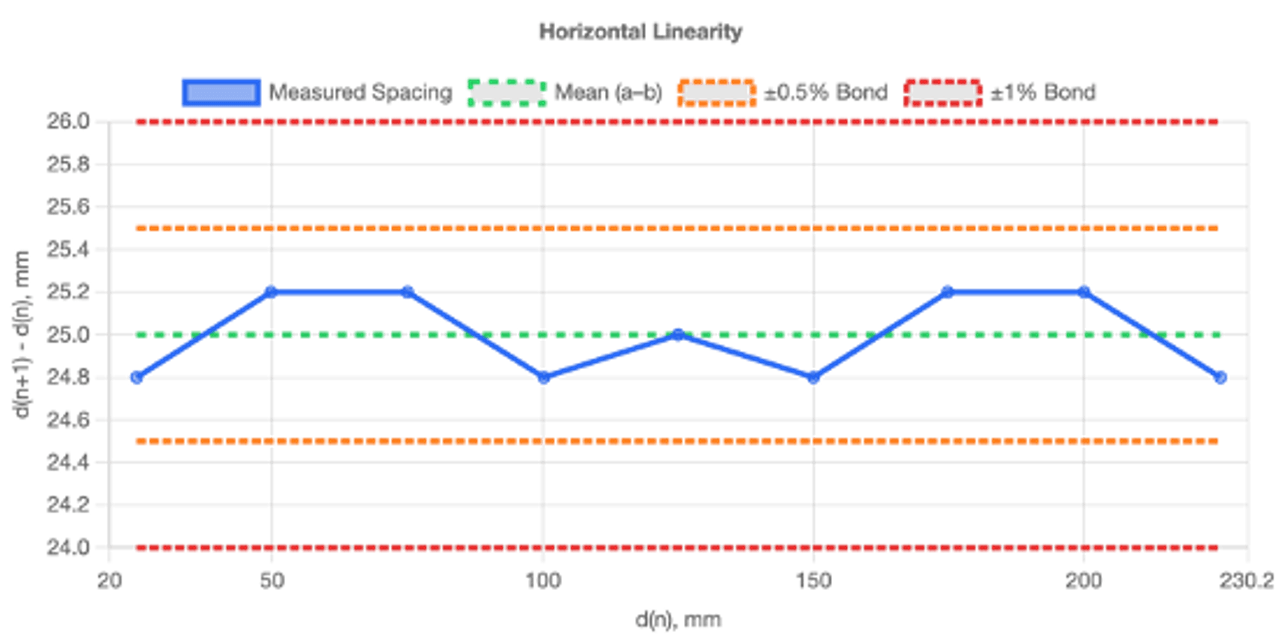
Successive back-wall echoes from a parallel-sided block are equally spaced by definition, so the intervals between them should all be identical. The chart plots each interval against echo position alongside the mean. A flat line at the mean is a linear instrument. A drifting line means the sweep speeds up or slows down across the screen. A single outlier is more often a misread echo than an instrument fault, so re-read it before condemning anything.
Read each echo at a consistent point, normally the leading edge at a fixed screen height. Ranges other than the one tested should be assessed separately, because the error is not necessarily the same at every range setting.
Vertical Linearity: AS 2083—2005
Adjust the gain so the centre echo h(n) sits at 10% of full screen height, then read the echo next to it. Add gain to bring h(n) to 20% and read the adjacent echo again. Repeat at 30%, 40% and so on up to 100% of full screen height.
You can edit both the forced center echo h(n) and the measured next echo h(n+1).
h(n) and h(n+1)
| Point # | Center echo h(n) | Next echo h(n+1) |
|---|---|---|
| 1 | ||
| 2 | ||
| 3 | ||
| 4 | ||
| 5 | ||
| 6 | ||
| 7 | ||
| 8 | ||
| 9 | ||
| 10 |
Reading the vertical chart
The physical ratio between two adjacent echoes is fixed and cannot change while you walk them up the screen. So any variation in the measured ratio between 10% and 100% of full screen height is instrument error, not a property of the block. The chart plots that ratio against screen height with the mean and deviation bands drawn in, which makes a gradual compression at the top of the graticule obvious in a way a column of numbers does not.
ASME BPVC Section V, Article 5 states the same requirement as a pass or fail instead of a plot: two reflectors set to a 2 to 1 amplitude relationship, the larger stepped from 100% down to 20% of full screen height, with the smaller reading half the larger within 5% of full screen height at every step. A separate check, amplitude control linearity, verifies the calibrated gain control itself.
How often, and what to keep
ASME BPVC Section V requires instrument linearity checks at the beginning of each period of extended use, or every three months, whichever is less. AWS D1.1 sets a maximum of two months for horizontal linearity and gain control accuracy. Most written procedures add a check after a repair or a drop.
The interval is the easy part. What causes audit findings is the record: proving that the instrument used on a particular job had been verified before that job, and that the technician holding it was in certification on the day. Both belong with the equipment rather than in a drawer. In AMPS the chart is filed on the instrument’s equipment page next to its calibration certificate, and the flag system gives a month of warning before the next check falls due, which is the same mechanism that watches personnel certifications and scheduled asset inspections.
For the background on each check, its acceptance criteria and the standards that define them, see horizontal linearity and vertical linearity.
Frequently asked questions
- What do the horizontal and vertical linearity checks tell you?
- Horizontal linearity tests the time base, so it governs whether a reflector is reported at the correct depth. Vertical linearity tests the amplitude display, so it governs flaw sizing and accept or reject decisions, which are written in amplitude terms in every ultrasonic code. An instrument can pass one and fail the other, which is why both are required.
- How do I use the horizontal linearity calculator?
- Couple a straight-beam probe to a block of known thickness, typically the 25 mm side of a V1 calibration block, and set the range so several multiple back-wall echoes are visible. Use four or five echoes for ranges up to 100 mm and ten to twenty for 100 mm to 500 mm. Enter the number of echoes and the graticule width, then type each echo position into the table. The chart plots the interval between successive echoes against position, with the mean and tolerance bands drawn in.
- How do I use the vertical linearity calculator?
- Pick a centre echo and the echo next to it. Adjust the gain so the centre echo sits at 10% of full screen height and read the adjacent echo. Add gain to bring the centre echo to 20% and read the adjacent one again, then repeat at 30%, 40% and so on up to 100%. Enter both heights at each step. The chart plots the ratio between the two echoes against screen height, so any drift in the ratio shows up as instrument error.
- Is the data I enter sent anywhere?
- No. Both calculators run entirely in your browser and nothing is transmitted or stored on a server. Use the copy or download button to save the finished chart to your own records.
- Does using this tool satisfy a code requirement?
- No tool can do that on its own. The calculators perform the arithmetic and produce a chart; the acceptance limit, the check interval and the record-keeping requirement come from the code or written procedure your work is performed to, and the completed record has to be retained with the instrument.